Cloud, On-Premises, or Hybrid? How to Store Your Security Data
In physical security, data is the backbone of every intelligent decision. Every camera feed, door, access control log, and sensor alert is a signal that shapes how quickly you detect threats, respond to incidents, and protect your environment.
But where you store that data determines speed, security, costs, and even the future scalability of your entire operation.
This blog gives a clear breakdown of the three primary deployment models: cloud, hybrid, and on-premises, along with guidance to help you understand which approach makes the most sense for your organization today, and how Thrive Logic supports you as you grow.
The Cloud: Security Without Boundaries
Cloud-based platforms store your data off-site in secure data centers, accessible anywhere through the internet. No servers to maintain, no manual updates, and instant scalability across locations.
Why organizations love it:
-
Scalability: Add cameras, analytics, or sites instantly.
-
Remote access: Manage everything from anywhere.
-
Reduced IT overhead: No physical servers to maintain.
-
Automatic updates: Always running the latest version.
Ideal for:
MSPs, fast-growing organizations, multi-site enterprises, clients with limited IT resources, and teams that want a plug-and-play model.
Example:
A retailer with 100+ stores manages all video and analytics through a single cloud dashboard, no local servers, no patching, no manual updates.
The tradeoffs:
-
Internet dependency: If your connectivity is weak, video recall can feel slower than on-prem.
-
Bandwidth burden: High-resolution video uploads may require strong upload speeds.
-
Less granular control: Great for most users, but highly regulated industries may still require local storage.
On-Prem: Maximum Control, Maximum Responsibility
On-prem systems store all data on servers physically located within your facility. You get full control — but also full responsibility.
Why organizations choose it:
-
Total control: You own the data, servers, and access policies.
-
Offline operation: Systems continue functioning with limited or no internet.
-
Deep customization: Purpose-built infrastructure for unique security needs.
Ideal for:
Government, defense, critical infrastructure, and organizations with strict regulatory or sovereign data requirements.
Example:
A military installation requiring zero external data flow keeps all video, analytics, and logs inside the base perimeter using on-prem infrastructure.
The tradeoffs:
-
Maintenance-heavy: You manage hardware, updates, and lifecycle replacement.
-
Takes physical space: Racks, cooling, power — they add up.
-
Scaling is slower and more expensive: Adding storage means buying more hardware.
Hybrid: The Best of Both Worlds
Hybrid setups combine local and cloud environments often storing mission-critical or high-bandwidth video on-site while pushing less sensitive or archival data to the cloud.
Think of it as real-time access meets long-term efficiency.
Why organizations love it:
-
Speed + security: Fast local access with cloud redundancy.
-
Flexible architecture: Choose which data lives where.
-
Regulatory alignment: Supports data sovereignty and privacy requirements.
-
Built-in resilience: Cloud backup ensures continuity during local failures.
Ideal for:
Hospitals, airports, enterprise campuses, and any environment needing low-latency video access while still maintaining cloud-level resilience.
Example:
A hospital stores patient-related footage locally for HIPAA compliance while pushing anonymized archival footage to the cloud for analytics and AI training.
The tradeoffs:
-
More architecture to manage: Balancing cloud + edge + local storage takes planning.
-
Cost structure is blended: You’re balancing two infrastructures instead of one.
-
Complexity: Without the right platform, hybrid can feel fragmented.
So, Which Model Is Right for You?
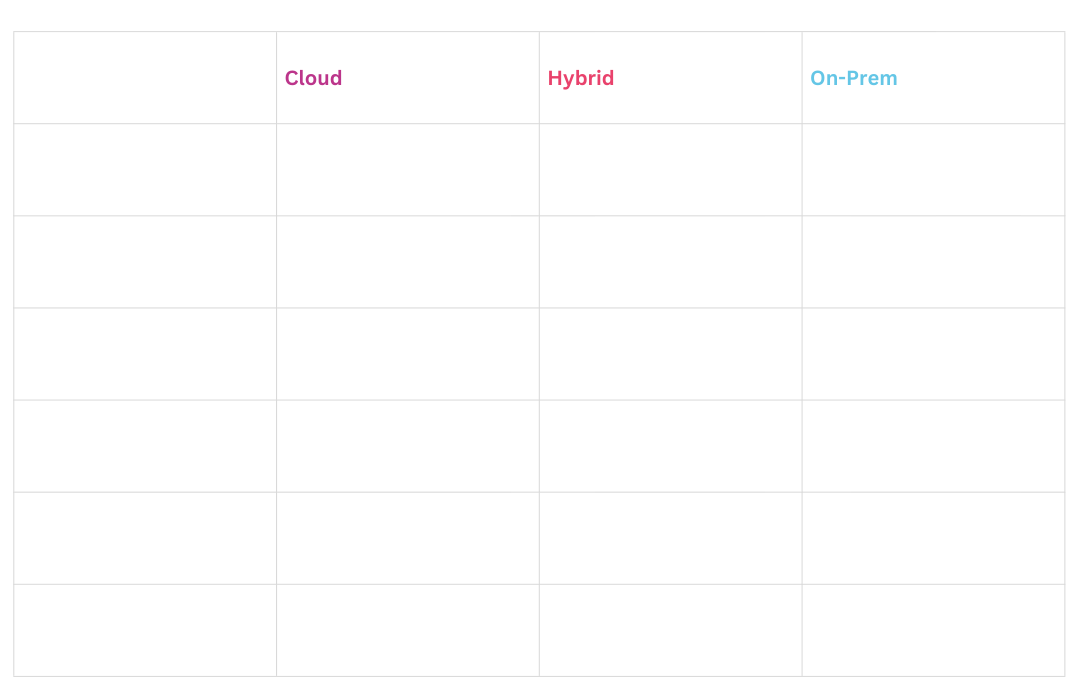
Every organization is somewhere on the modernization curve, from legacy NVRs and DVR rooms to multi-site cloud deployments. What matters most is choosing an architecture that meets you where you are and allows you to grow without disrupting your operations.
To help you compare, here’s a simple breakdown:
Every model has tradeoffs.
Cloud introduces internet dependency.
On-prem demands maintenance and hardware.
Hybrid adds architectural complexity.
Thrive Logic is engineered to smooth these differences out. Delivering consistent visibility, AI analytics, and performance across all three models.
A Modernization Path at Your Pace (Crawl → Walk → Run)
Whether you’re just moving off aging NVRs or planning large-scale AI adoption, Thrive Logic helps you transition without ripping out what already works.
• Crawl: Establish foundations with modern VMS and Access Control.
• Walk: Introduce fundamental AI Analytics and centralize data into Thrive VARCA.
• Run: Scale to multi-site cloud, advanced automation, or agentic security workflows.
No forced migrations. No hardware lock-in.
Just smarter security at the speed that fits your team
Our Takeaway
How you store your data should support, not limit, your security strategy. Thrive Logic is built to adapt to your storage model, your regulatory needs, and your growth path.
Whether you operate 100% cloud, air-gapped on-prem, or somewhere in between, our platform delivers:
-
Real-time visibility
-
Faster investigations
-
AI-powered analytics
-
Seamless scalability
-
Consistent performance across deployments
You choose the model. We make sure it works flawlessly.
Get Your Free Storage & Deployment Assessment
Not sure which model fits your organization best?
We’ll analyze your current infrastructure, constraints, bandwidth, compliance needs, and growth goals and give you a clear recommendation.
No cost. No pressure. Just clarity.
👉 Schedule a free deployment assessment with our team by clicking the button below
👉 Or book a demo to see how Thrive Logic adapts to any storage model

Elevate Security. Unify Data. Thrive with AI-Driven Insights.